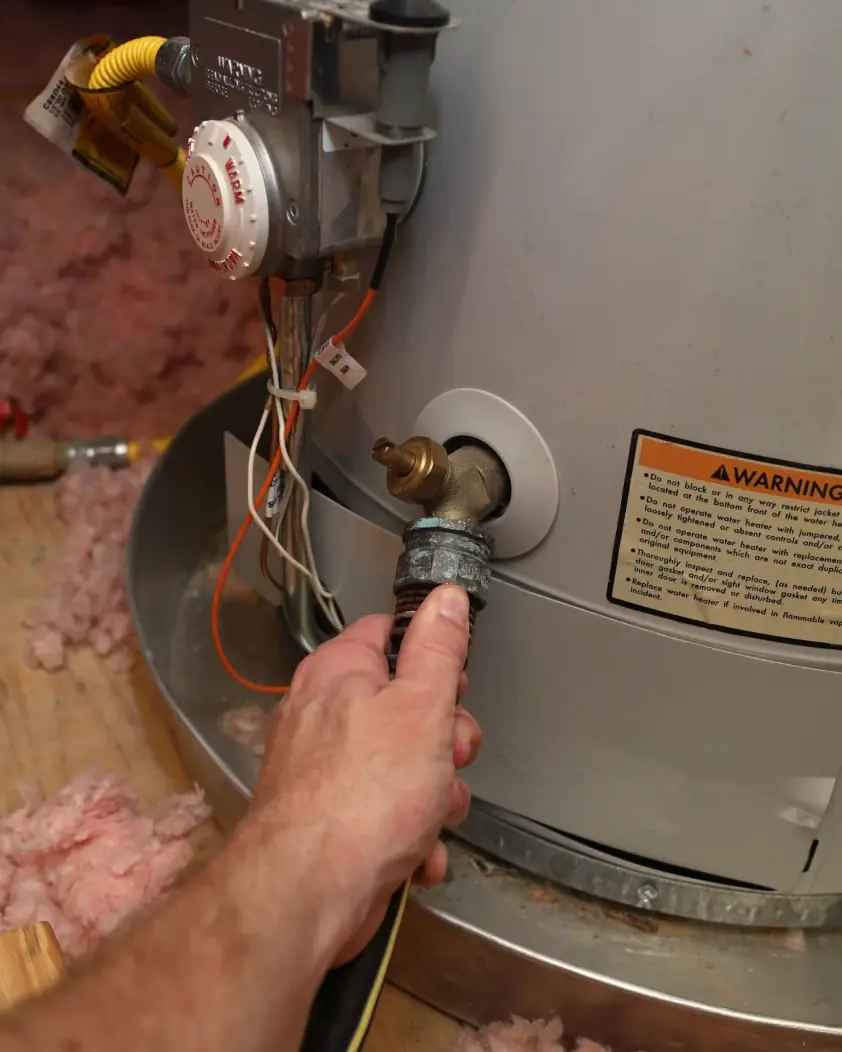
How we approach a water heater repair
A water heater that stops making hot water rarely fails all at once. Something small gives out first: a heating element burns through, a thermocouple stops sensing the pilot, a relief valve starts to weep, or sediment builds up until the burner or lower element can no longer heat the water efficiently. Most of those failures are parts problems, and parts can be replaced. Our job on a repair call is to find the one part that actually failed, prove it with a meter or a visual check, and fix it without selling you anything you do not need.
Foothills Water Heaters works on nothing but water heaters, which changes what a repair visit looks like. We carry the common thermostats, elements, thermocouples, gas control valves and relief valves for the major brands on the truck, so most repairs are finished on the first visit rather than after a second trip to a supply house. We service the heaters you are most likely to find in a Hickory basement, garage or closet, including A.O. Smith, Rheem, Bradford White, State, and the Whirlpool and GE units sold at home centers, as well as Rinnai, Navien and Noritz tankless heaters.
Every repair call follows the same order:
- Listen first. What is the heater doing, when did it start, and has anything changed in the house? A new bathroom, a tripped breaker or a recent power outage can all point toward the answer.
- Check the basics. Power at the unit or gas supply to the valve, the thermostat setting, the breaker and the high-limit reset. It is surprising how often the fix starts here.
- Test the components. On an electric heater we meter each element and thermostat. On a gas heater we check the pilot, thermocouple or flame sensor, the igniter, the gas valve and the draft on the flue.
- Inspect the tank. We look for moisture at the seams, rust around the fittings, water in the drain pan and signs of scale or sediment. This is what tells us whether a repair will last.
- Put it in writing. You get a written price for the repair before we start. If the heater is old enough that replacement deserves a look, we give you that number too, side by side.
Electric water heater repairs
Most electric tank water heaters have two heating elements, an upper and a lower, each controlled by its own thermostat, plus a high-limit switch that cuts power if the water ever gets too hot. When an electric heater goes cold, one of those five parts is usually to blame.
- No hot water at all. Often the upper element or upper thermostat has failed, or the high-limit switch has tripped. The upper element heats first, so if it is dead the lower one never gets its turn. We find out why the high-limit tripped instead of simply pressing the reset button.
- Lukewarm water or hot water that runs out fast. Frequently a failed lower element. The top of the tank still heats, so you get a short burst of hot water and then it fades. On an older tank the same symptom can come from a broken dip tube that lets cold water mix at the top.
- Breaker keeps tripping. A shorted element or a damaged wire at the terminal block. We check the wiring and connections, because a loose or scorched terminal is a fire risk, not just an inconvenience.
- Hot water that is far too hot. A stuck thermostat. This one needs attention quickly for scald safety.
Element and thermostat replacements are routine repairs on a sound tank. The water gets shut off and drained below the element, the old part comes out, the new one goes in with a fresh gasket, and we refill the tank completely before power goes back on. Energizing an element in a dry tank destroys it in seconds, which is one of the most common mistakes we see on do-it-yourself repairs.
Gas water heater repairs
Natural gas is common in and around Hickory, while a lot of homes out in the county run their water heaters on propane. Gas heaters fail in their own ways, and most of those failures are in the control system rather than the tank.
- Pilot will not stay lit. The classic cause is a worn thermocouple or, on newer units, a dirty or failing flame sensor. Sometimes the problem is draft: if the flue is not pulling properly, combustion gas can roll back and snuff the pilot. We check both, because swapping a thermocouple on a heater with a venting problem only hides the real issue.
- Burner lights, then shuts off. Often a sensor, a flammable-vapor safety device on the burner chamber, or a gas control valve that is starting to fail.
- No ignition on a newer unit. Electronic igniters and hot-surface igniters wear out. Power-vent models add a blower and pressure switch that can also stop the sequence.
- Gas smell near the heater. Leave the area, do not operate switches near the heater, and call your gas utility or propane supplier from outside the home. Once the supply is safe, we can repair the heater side of the problem.
On every gas repair we take a look at the vent connector and flue, the gas shutoff and the combustion air around the heater. A heater that has been starved for air or venting poorly will keep failing no matter how many parts get replaced.
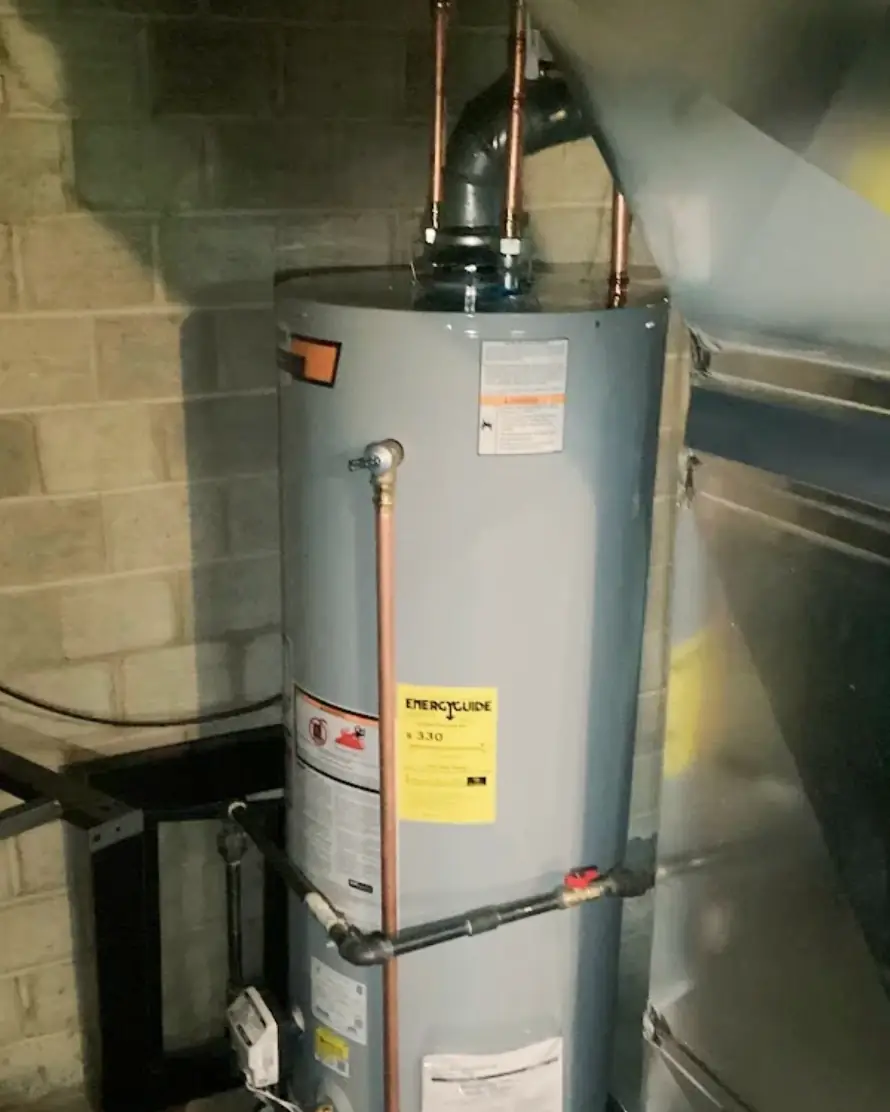
Leaks: when a repair works and when it will not
Water on the floor is the call that worries homeowners most, and it is the one where an honest diagnosis matters most. Where the water is coming from decides everything.
Leaks that are repairs: a dripping drain valve at the bottom of the tank, a weeping temperature and pressure relief valve, a loose or corroded fitting on the hot or cold supply lines, a failed element gasket on an electric unit, or condensation that looks like a leak on a cold morning. All of these can be fixed, and a tank that is otherwise sound can keep going for years after the repair.
Leaks that are not: water coming from the tank itself, from a seam, from under the jacket, or seeping up through the insulation. Once the steel tank has rusted through, no patch will hold, and the leak will only get worse. We will tell you so before you pay for parts, and we can quote a water heater replacement the same visit.
A relief valve that drips is a special case. The valve may simply be worn, but it may also be doing its job because pressure in the tank is climbing. On homes with a check valve or pressure-reducing valve on the main line, thermal expansion has nowhere to go, and an expansion tank is often the real fix. Replacing the valve without addressing the pressure just means a new valve that drips.
Noises, sediment and rusty or smelly water
Popping, rumbling or crackling from the tank is almost always sediment. Minerals settle to the bottom, trap pockets of water under a crust, and the water flashes to steam as the burner or lower element heats it. It sounds dramatic, it wastes energy, and over time it overheats the bottom of the tank and shortens its life.
That is especially true on private wells, which are common in Alexander, Caldwell and Burke Counties. Well water often carries more sediment and minerals than municipal water from the Catawba River system, and heaters on wells benefit from more frequent flushing. On a younger heater, a flush clears most of the buildup. On an old tank with years of hardened scale, a flush may not move much, and that is useful information for the repair-or-replace decision.
Rusty hot water usually points to the anode rod. The anode is a sacrificial metal rod that corrodes so the tank does not. When it is used up, the tank starts to rust from the inside. Replacing a spent anode on a younger heater is one of the best-value repairs there is. A rotten-egg smell in the hot water is also an anode issue in most cases: sulfur-reducing bacteria in some well water react with a standard magnesium anode, and a different anode material usually solves it.
Tankless water heater repairs
Tankless heaters are reliable, but they are more sensitive to water quality than a tank. Scale builds up inside the heat exchanger, especially on hard or well water, and the unit starts throwing error codes, cycling on and off, or delivering water that swings between hot and cold. Descaling the heat exchanger with a pump and cleaning solution, cleaning the inlet filter and checking the venting clears many of those calls.
Other common tankless issues include ignition failures, flame-sensing faults, blocked condensate drains on condensing models, and flow sensors that stop registering demand. We read the error history, test the component the code points to, and repair it. If you are thinking about moving from a tank to tankless, our tankless water heater installation page explains how we size and install them for Foothills water.
Is it worth repairing?
The honest answer depends on three things: how old the heater is, what failed, and whether the tank is still sound. You can find the manufacture date encoded in the serial number on the rating label, usually as a letter or number for the month and two digits for the year.
| Situation | Usually repair | Usually replace |
|---|---|---|
| Age | Under about 8 years | Past 10 to 12 years |
| What failed | Element, thermostat, thermocouple, igniter, gas valve, relief valve | The tank itself |
| Water on the floor | Fitting, drain valve or relief valve | Seam, jacket or tank body |
| Cost of repair | Well under half the price of a new heater | Approaching half the price of a new heater on an older unit |
| Hot water supply | Enough once the part is fixed | The household has outgrown the tank |
If the numbers point toward replacement, we will say so plainly and give you a written quote for both options. If a repair makes more sense, we will fix it and tell you what to watch for so you get the most years out of the heater. The full comparison is on our repair or replace guide.
What you can safely check before you call
- Electric heater: check the breaker. If it has tripped once, you can reset it. If it trips again, leave it off and call, because something is shorting.
- Gas heater: confirm other gas appliances work and the gas valve on the supply line is open. Follow the lighting instructions on the label if the pilot is out. If it will not stay lit after one attempt, stop there.
- Leak: turn off the cold water supply valve at the top of the heater, then shut off the power or set the gas control to off or vacation. A little water on the floor can wait for us; a steady stream means shutting off the main water supply to the house.
- Relief valve: never cap or plug a relief valve or its discharge line, even if it is dripping. It is a safety device that prevents a tank from failing under pressure.
When you call (828) 471-7706, tell us the brand, whether it is gas or electric, roughly how old it is and what it is doing. That short conversation is how we arrive with the right parts.
Water heater repair across the NC Foothills
We are based in Hickory and repair water heaters for homes throughout Catawba, Caldwell, Alexander and Burke Counties, including Hickory, Conover, Newton, Claremont and Maiden; Lenoir, Granite Falls, Hudson, Sawmills and Cajah's Mountain; Taylorsville, Hiddenite, Stony Point, Bethlehem and Ellendale; and Morganton, Valdese, Drexel, Hildebran and Connelly Springs. If your town is not listed, call and ask. See the full service area for details.